If you type "Sunset Park" into your GPS, you'll probably end up a mile from the action, staring at a duck pond while 24 pickleball games buzz in the distance. The Sunset Park Pickleball Complex is the largest public court system in Las Vegas, and showing up without knowing the park layout is a fast track to the sidelines. Here's how to handle the busiest courts in Nevada.
Finding the courts and parking
Sunset Park spans more than 300 acres. This Clark County park has a lake, disc golf courses, dog parks, and baseball fields, so entering through the main gate off Sunset Road is a mistake if you're here to play pickleball. The walk from the main entrance to the courts in the southwest corner is long, and hauling gear across it in the desert heat is miserable.
Instead, drive past the main gates and enter via McLeod Drive on the western edge of the park. Look for a distinct gray and white building — that's the county Sports Unit office. The lot right next to it puts you at the edge of the courts.
That lot fills up fast at peak hours: the morning rush runs 7:00 to 11:00 AM and the evening rush 6:00 to 9:00 PM. If it's full, you'll park in the secondary dirt lots further north along McLeod Drive and walk down.
24 courts, two rule sets
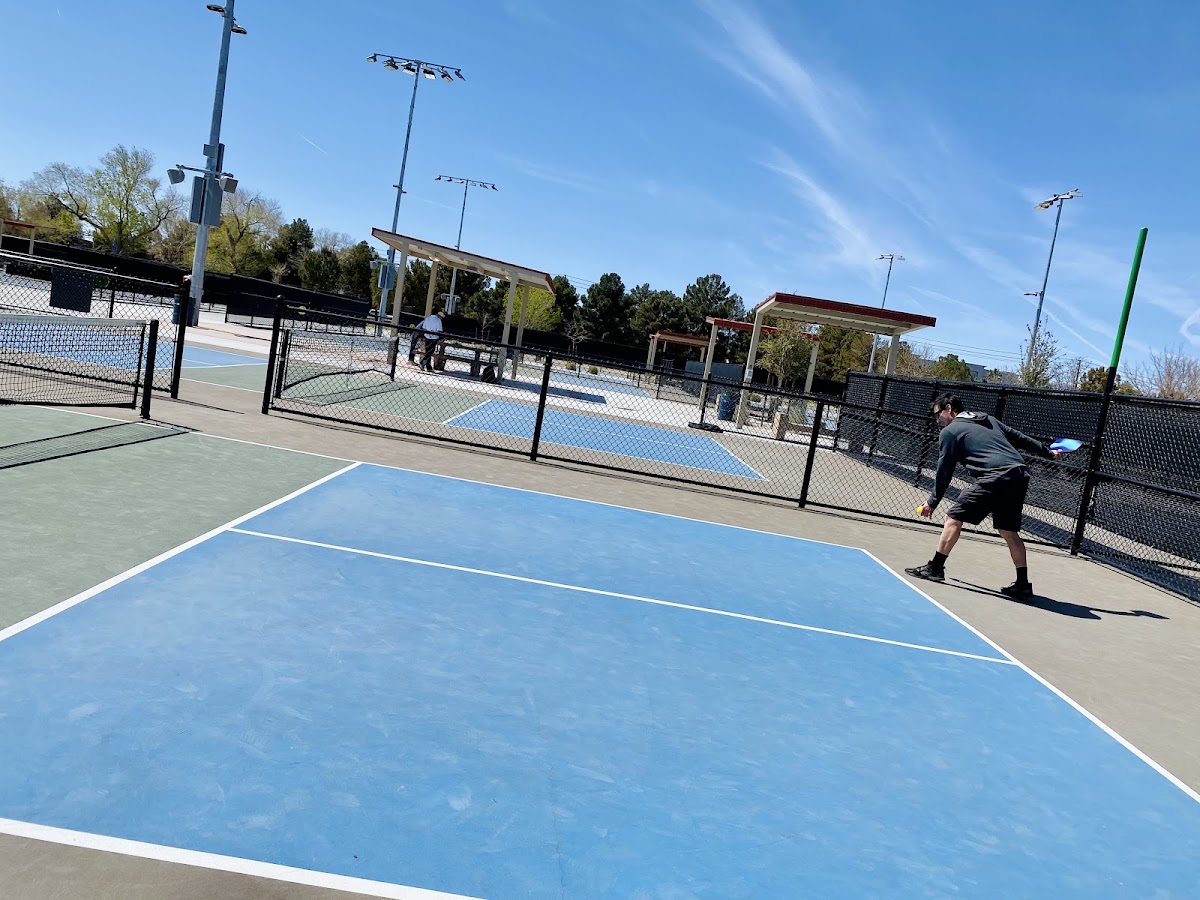
The complex has 24 outdoor courts surfaced in green and blue acrylic. They aren't a free-for-all — Clark County splits them into zones with different access rules.
The 20 public open-play courts
Courts 5 through 24 are open to the public daily from 6:00 AM to 11:00 PM, free for drop-in use. The layout divides them into fenced banks of four, which contains most stray balls, though a hard-sliced drive can still find its way into a neighboring game.
Night play is where the park comes alive during the hot summer months, and the lighting is built for it. The LED court lights stay on until 11:00 PM sharp — no warning flash, no buzzer. When the clock hits 11, the courts go dark, so lock in your final scores before then.
The 4 reserved courts
Courts 1 through 4 are the dedicated championship courts, usually locked and set aside for tournaments, clinics, and official county league play. Hopping on when they look empty is a quick way to get asked to leave by park staff.
If you want a guaranteed court without waiting in the public rotation, you can reserve drop-in courts through Clark County Parks and Recreation for $6 per hour. That's the move for an organized group that wants to run a structured ladder or mini-tournament without fighting the public queue.
| Court Numbers | Category | Access Rules | Best For | Cost |
|---|---|---|---|---|
| 1–4 | Championship courts | Reserved for county events, leagues, and tournaments | Official tournament matches | Closed to drop-ins |
| 5–8 | Challenge courts | Public open play, win-and-stay rotation | Competitive singles and doubles | Free |
| 9–12 & 17–20 | Open play | Public drop-in, paddle-queue rotation | Recreational and social groups | Free |
| 13–16 & 21–24 | General public / reservations | Public drop-in unless reserved | Standard matches and scheduled groups | Free (or $6/hr to reserve) |
Open play and paddle rack politics
The social structure here is organized, and locals expect newcomers to respect it. Walk onto an empty court while people are waiting, or ignore the paddle queue, and you'll get corrected fast.
The rotation shifts with the crowd. During off-peak afternoons, players run a standard 2-on-2 where the winning team stays and the losing team rotates off. When it's busy — especially the cooler evening hours — it changes to 4-on-4, meaning all four players clear the court after a game so a fresh group of four can take over.
For competitive matches, head to Courts 5 through 8, the designated Challenge Courts. Anyone can drop a paddle in the queue, but the pace is higher and the rules are strict:
- Games to 11 points, win by 1.
- Winning partners can stay a maximum of two consecutive games.
- After two wins, the winning team rotates to the back of the queue if others are waiting.
- Losing players rotate off immediately.
Compared to other big municipal hubs, the wait here is manageable, mostly because of the sheer court count. The 24-court layout keeps the rotation moving, so you rarely wait more than a game or two to get back on. Denver's public courts run into the opposite problem — we ranked them here.
The verdict, scored
Surface and net quality: 9/10
The acrylic surfaces are flat, true, and free of major cracks or dead spots. The nets are kept at proper center height. The fencing between banks blocks most stray shots, though you'll still call the occasional let for a ball rolling in from the side.
Wind and elements: 5/10
The biggest drawback. Sitting in an open stretch of the Las Vegas valley, the complex is exposed, and the fences lack heavy windscreens. A 15 mph gust turns a plastic ball into an unpredictable projectile. If the forecast calls for high wind, expect a frustrating day.
Vibe and community: 8/10
The crowd is active, skilled, and generally welcoming if you follow the paddle-stack rules, ranging from 2.5 rec regulars to 5.0 tournament players. It can feel cliquey during peak night hours, and beginners may find the fast challenge courts intimidating.
Logistics and amenities: 7/10
The McLeod Drive entrance is a huge convenience once you know it exists, and clean public restrooms sit right next to the courts. The 11:00 PM cutoff is great for night owls. The gap: almost no shade near the waiting benches, which makes late-spring and summer daytime play brutal.
Come with a group
If you're tired of herding a group text every time you want to run a rotation at Sunset Park, KrazyPickles keeps your krewe, match results, and standings in one place for free. Sign in, invite your friends, and spend the McLeod Drive parking hunt arguing about the lineup instead of the spreadsheet.