For twelve years, the four courts lined on the tennis asphalt at Seger Park in Philadelphia were Center City's most energetic, chaotic, and community-driven pickleball hub. That run hit a wall in early 2026, when Philadelphia Parks & Recreation abruptly canceled the park's official Meetup program and left thousands of local players without an organized system. Playing at the corner of 10th and Lombard now takes actual strategy. Here is the honest state of the courts.
What most people get wrong
Walk up to 10th and Lombard expecting a casual, city-funded park you can slide into, and you are in for a rude awakening. The four pickleball courts at Seger Park do not exist because of generous municipal planning. They exist because neighborhood volunteers fought to build them. Over the last decade, the Seger Park Advisory Council worked with local council members to raise private funds for every major upgrade: resurfacing the tennis courts in 2022, painting the dedicated pickleball lines, installing overhead LED lights in 2023, and hanging the wind screens. It is a fiercely protected local ecosystem, and walking on without knowing that history is a fast way to create friction.
The courts and the shared-space compromise
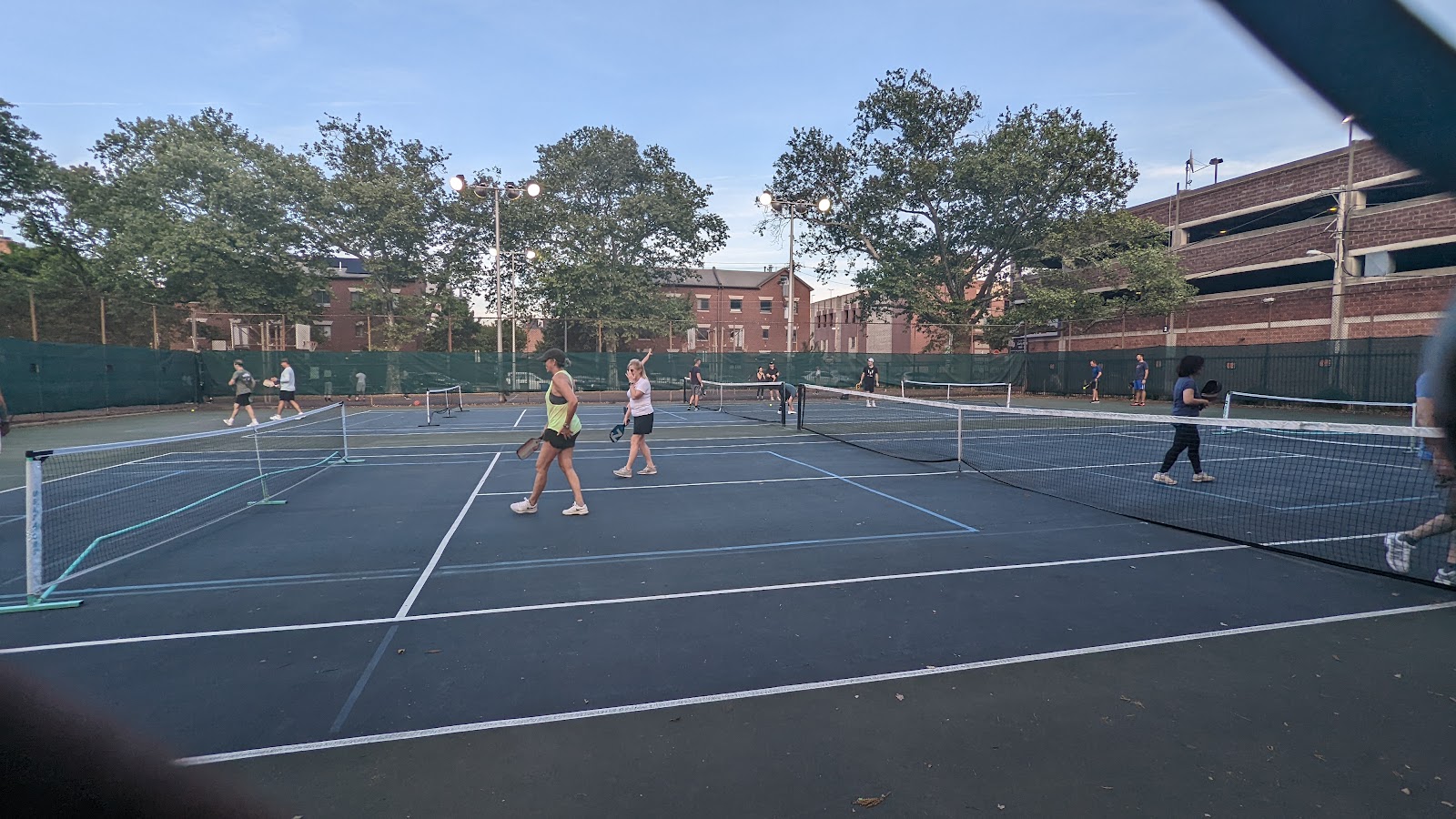
You are not playing on dedicated, fenced-off pickleball courts. You are on a multi-sport surface where tennis and pickleball share an uneasy, painted marriage, and that requires constant negotiation.
The surface and the lines
The playing surface is standard hardcourt asphalt in a green and blue layout. The 2022 resurfacing smoothed out the major cracks and dead spots that plague older Philly parks. But the visual clutter is intense: four sets of yellow pickleball lines painted on top of two active tennis courts. If you have played multi-lined courts, you know the pain of calling a ball out with three colors competing for your attention. It takes a few games to train your eyes onto the pickleball dimensions.
The net situation
Do not expect permanent metal nets with heavy center straps. Seger uses portable nets kept assembled on the sidelines, and players manually wheel or drag the heavy frames onto the court when a tennis match ends and a pickleball match begins. That handoff is a constant source of friction. Tennis players want every second of their reserved hour, and pickleball players hover at the baseline waiting to roll the nets out. It is a polite but firm negotiation every hour, and if a frame is damaged or missing a tension strap, your game is dead unless someone brought a backup.
The death of the 4,000-person Meetup
For over a decade, the chaos was held together by a volunteer-run organization. The Seger Park Pickleball & Table Tennis Meetup managed open play, ran beginner clinics, and grew to nearly 4,000 members. It ended in early 2026 when Philadelphia Parks & Recreation abruptly canceled all organized programs at the park, wiping out a 12-year effort that had raised thousands of dollars for court maintenance, wind screens, and LED lighting. With the public Meetup gone, the era of showing up alone and slotting into a paddle lineup is over.
The noise problem hanging over the courts
Pickleball is loud, and in a dense neighborhood like Washington Square West that noise is a political lightning rod. The sharp pop of a plastic ball off a composite paddle bounces off brick rowhomes and narrow streets. Philadelphia has already fought this battle a few miles north, where the Water Tower Recreation Center in Chestnut Hill became ground zero for the city's pickleball noise wars. Neighbors there formally notified the city that court noise was a nuisance, registering 75 to 79 decibels during active games. The backlash led Philadelphia Parks & Recreation to cut playing hours by over 30 percent and ban Sunday play entirely. Seger has not faced the same formal notices yet, but the threat of restricted hours hangs over every match, which is one more reason to keep games inside the allowed municipal hours.
How to actually play there this season
With the public programs gone, you need to know the local system or you will spend the afternoon on a bench. There are two paths: an official reservation or the walk-up queue.
The reservation system
The reliable way to guarantee court time is the official membership system run by the Seger Park recreation center. You can call the rec center directly at (215) 686-1780 to ask about membership and reserve courts. Reservations change strictly on the hour. If you hold one, you have the right to wheel the portable nets onto the tennis asphalt and claim your space, but the slots are coveted by local tennis players and established pickleball groups alike. Snag one and you need to arrive exactly on time with your full group, because any delay lets walk-up players take the court.
Surviving first-come, first-serve
Without a reservation, the courts default to first-come, first-serve, and that is where the drama is. Because the courts change on the hour, a queue usually forms around 15 minutes past. To survive it, you need a coordinated crew ready to claim an open court the second the clock turns. Show up solo in the post-Meetup era and your chances of getting into an existing game are slim.
Build your own crew
The Seger Park shutdown is a reminder that public court access is never guaranteed. With the city-run Meetup gone, organizing your own games is the way to keep playing. A free krewe on KrazyPickles lets you build a private group, invite local players by SMS or email, schedule matches, and track progress with an Elo-style ranking, all without a password to sign in. Sign in here to start one. For another city wrestling with court access, see our Boston wait-times guide.